

Loading...
Postulate is the best way to take and share notes for classes, research, and other learning.
An Introduction to Modeling Flexible Spacecraft Dynamics for Space-Based Solar (Research Notes)
 Caitlyn Coloma
The following presents the motivations and methods described in the 2021 paper "Reduced-order modeling for flexible spacecraft deployment and dynamics" and is not my own work.
Motivation
Traditional spacecraft = mostly rigid with moving parts attached. Rigid objects are easy to plan movements for (we refer to these movements as control and dynamics). But new spacecraft that support applications like space-based solar power are mostly non-rigid; they need to be flexible and feature many moving parts. Namely, space solar spacecraft are ultralight, packageable, and self-deployable*:The problem is simulating these spacecraft and all their moving parts. The increased flexibility introduces new challenges for accurately simulating the dynamics of ultralight, flexible spacecraft.
ultralight: launch costs are proportional to payload mass + moving parts are easier to move and control if lightweight
packageable: large solar arrays need to fold up and fit inside rockets
self-deployable: once in space, the spacecraft needs to unfold and unpackage itself from the launch vehicle
Method
A reduced-order model (ROM) is used in a floating frame of reference (FFR) to simulate the elastica catapult problem, which has dynamics analogous to flexible spacecraft dynamics.
Problems with current ROMs for such spacecraft stem from needing to accurately model a combination of:
large (geometrically nonlinear) deformations— localized changes to shape or sizelarge rigid body motions— movement of the spacecraft as a whole, its translation through space
Why ROMs?
When modeling a complex system, engineers want high fidelity; they want their model to be highly representative of the real world. This translates to lots of variables to account for, which take up lots of computational power and time in order to run simulations. ROMs simplify these complex models by reducing state space dimensions or degrees of freedom so that engineers can study systems using minimal computational resources.
ROMs are used to simulate deployment, structural dynamics during maneuvers (shorter timescales), structural dynamics during orbital periods (longer timescales), and trajectory optimization and control.
Why FFR?
"Proper use of model order reduction allows to analyze complex system at a high level of accuracy and reduced computational cost" (Recuero & Negrut)
"The FFR method differs significantly from general corotational methods by the fact that it requires only one dynamic configuration for each element" (Lozovskiy & Dubois)
"In the FFR formulation the motion of a point of a body is composed of the motion of it’s reference (rigid motion) plus the the motion of the point with respect to its reference (deformation)" (Gerstmayr)
A floating frame of reference (FFR) allows a flexible body with many moving parts (and geometrically nonlinear deformations) to be described by a single formulation consisting of 2 coordinate systems: reference coordinates representing a rigid body of motion and elastic coordinates representing deformations.
The alternative to FFR is having each moving part (element) being described by its own set of parameters and equations, which amounts to a harder-to-manage collection of equations and in turn higher computational cost.
Why the elastica catapult?
The elastica catapult problem is chosen as a relevant benchmark problem for assessing the efficacy of reduced-order modeling methods for ultralight, flexible spacecraft.
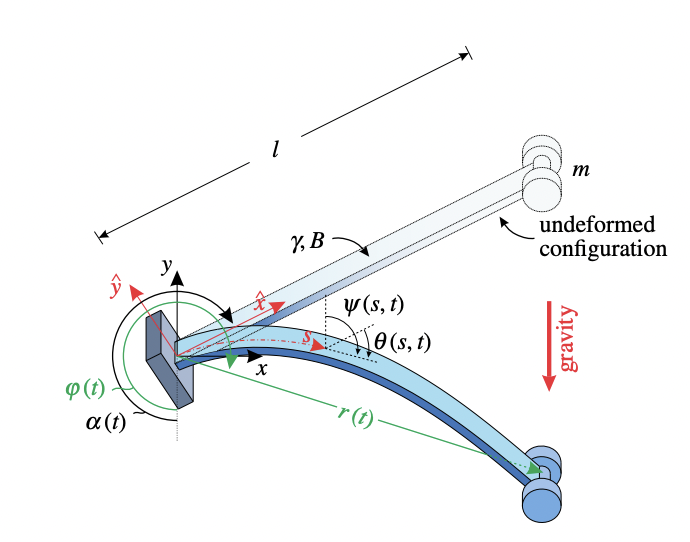
The deformation in the elastica catapult is like the energy release for dynamic deployment and localized folding in ultralight flexible spacecraft.