

Loading...
Postulate is the best way to take and share notes for classes, research, and other learning.
Does development lead to democracy?
 Samson Zhang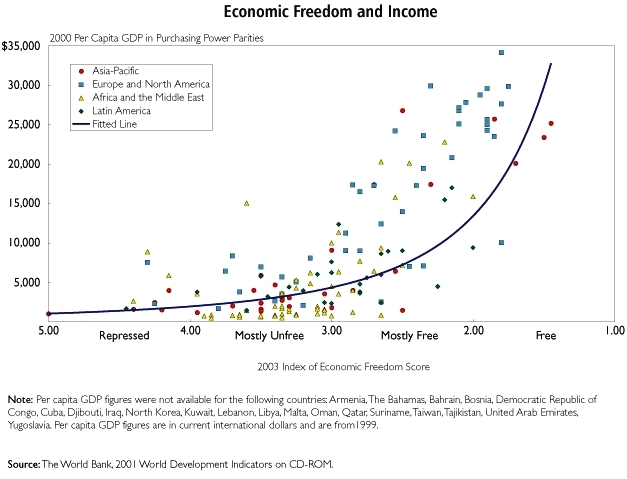
The classical modernization theory explains the correlation between income and democracy by arguing that development causes democratization. Lipset (1959, advancing both classical and exogenous modernization theory) advances Daniel Lerner’s theory that industrialization leads to urbanization, which leads to education and literacy, which leads to mass media, which leads ultimately to a country’s people having the ability and desire to vote on their governance, at which point a democracy is likely to replace an authoritarian regime.
Przeworski and Limongi (1997) provided empirical evidence against the classical modernization theory when they found that dictatorships have statistically been robust at both high and low income levels and that, among countries that gained independence after 1950, authoritarian regimes did not become any less stable as they developed.
Exogenous modernization theory instead explains the income-democracy correlation with the model that authoritarian regimes are replaced by democratic ones for non-economic or even random reasons, but democratic regimes are more likely to survive at higher income levels than lower ones, leading to more high-income democracies and more low-income authoritarian regimes over time.
Przeworski and Limongi agree with several causal explanations that Lipset proposed for the exogenous modernization theory. Revolts only happen when the lower class “have nothing to lose,” so a relatively wealthier lower class contributes to overall stability, Lipset/Przeworski and Limongi argue. A wealthier lower class is also more likely to be respected by the upper class; for the upper class, larger amounts of individual wealth also decrease the marginal utility of gaining more wealth, de-incentivizing them from attempting to destabilize existing regimes and seize power. Lastly, a large middle class rewards moderate politics with votes and penalizes extremist groups, contributing to democratic legitimacy and stability.
The dependency critique of modernization argues that in a global capitalist system, the underdevelopment of many impoverished countries is a consequence of the development of established Euro-American economies or developed city centers on which the impoverished countries and regions depend, rather than an indication of their inability to develop on their own. Thus many less-developed countries that gained independence recently are “underdeveloped” in a fundamentally different way than European countries were “undeveloped” in the past, and modernization theory does not apply.
Frank (1966) provides a litany of empirical analyses showing the negative impact of metropole influence on satellite development, including that Latin American economies developed most when European powers were occupied with economic depressions or wars, development that fades when the European powers return; and that the most impoverished regions of the world today were the ones with closest ties to metropole economies in the past, such as former sugar-exporting and mining areas.
A pure per capita income metric doesn’t fully capture development because lower costs might lead to more production and development at lower income levels for a country. Adjusted metrics like purchasing power parity account for this. Development can also be measured by metrics like urbanization and education that income doesn’t necessarily reflect.
Original prompt -- Answer the following questions in no more than 500 words in total.
- The graph below illustrates the empirical relationship between a country’s level of income and its level of democracy. How does classical modernization theory explain this relationship? How is exogenous modernization theory different?
- How is a country’s level of “development” similar to and different from its level of income?
- What is the dependency critique of modernization?
Comments (loading...)
Poli 5: Intro to Comparative Politics
Notes for Pomona class Poli 005: Intro to Comparative Politics